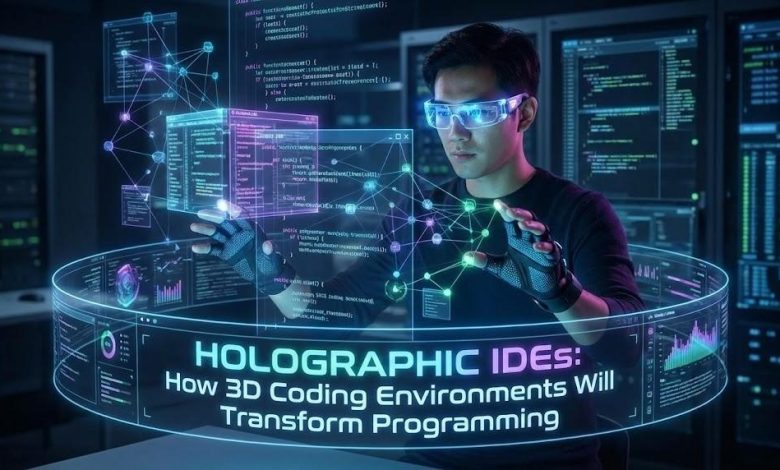
The arrival of holographic IDEs is changing the world of programming. These 3D coding environments are making coding more fun and interactive. They’re set to change how developers work.
With holographic tech, developers can see complex code in 3D. This makes it easier to understand and work with. It’s a big step towards a more interactive way of coding.
This change is expected to make developers more productive and creative. It’s a big leap forward for software development.
Key Takeaways
- The introduction of holographic IDEs will revolutionize programming by making it more immersive.
- 3D coding environments will enhance developers’ understanding of complex code structures.
- These innovative tools are expected to boost productivity in software development.
- Holographic IDEs will make coding more interactive and engaging for developers.
- The shift towards holographic technology is set to drive innovation in the tech industry.
The Current Limitations of 2D Programming Interfaces
The current 2D coding environments face growing challenges as programming gets more complex. As we look ahead to 2026, the need for better coding tools is clear.
Screen Real Estate Constraints
One big issue is the limited screen space. Developers must manage many files, documents, and tools at once. This makes their workspace messy.
Using bigger screens or more monitors helps a bit. But it doesn’t solve the main problem of dealing with complex code in a 2D space.
Cognitive Load of Multiple Windows and Tabs
Handling many windows and tabs is hard on the mind. Moving between different views and tools can be a distraction. It can also mess up the development process.
- Increased mental fatigue due to constant context switching
- Difficulty in maintaining focus on the task at hand
- Potential for errors due to misplaced or lost information
Visualization Challenges for Complex Systems
Complex systems are hard to visualize in 2D. It’s tough to show complex code structures and dependencies clearly.
Augmented reality coding and other new technologies might help. They could make coding more intuitive and immersive.
The Evolution of Development Environments
Development environments have changed a lot over time. They’ve moved from simple command-line interfaces to today’s integrated and collaborative coding platforms. This change shows how technology has evolved and how developers need better tools to work efficiently.
From Command Line to Graphical Interfaces
The move to graphical interfaces was a big step forward. These interfaces made coding easier and more intuitive. Microsoft’s Visual Studio and other IDEs brought even more tools together, boosting developer productivity.
The Rise of Integrated Development Environments
IDEs have changed how we develop by combining many tools into one place. This makes workflows smoother and reduces the need to manage many apps. Features like code completion and debugging are now key for developers.
Cloud-Based Collaborative Coding Platforms
Cloud-based platforms have taken development to the next level. They allow for real-time collaboration and remote work, improving teamwork and productivity. Key features include:
- Real-time Collaboration Features: Allowing multiple developers to work together in real-time, regardless of their physical location.
- Version Control Integration: Ensuring that changes are tracked and managed effectively, reducing the risk of conflicts and errors.
As development environments keep evolving, we can expect even more advanced tools. The integration of hologram developer tools and immersive coding environments will likely bring even more sophisticated features for developers.
Understanding Holographic IDEs and 3D Coding Workspaces: The Future of Programming
The future of coding is coming in three dimensions. Holographic IDEs and 3D coding workspaces are changing how developers work. These changes are thanks to spatial development tools and mixed-reality programming. They make coding more immersive and interactive.
Definition and Core Technologies
Holographic IDEs use holographic displays and spatial computing for an immersive coding experience. They rely on advanced rendering engines and spatial mapping systems. These technologies create a seamless and interactive coding space.
Hardware Requirements for Immersive Development
Holographic IDEs need advanced hardware for immersive development. This includes high-resolution displays, advanced sensors, and powerful processing units. These components ensure a smooth and responsive experience, helping developers focus on their work.
Software Architecture for Spatial Computing
The software behind holographic IDEs is complex. It involves multiple components for a cohesive experience. Key elements include:
- Rendering Engines: These engines create the visual elements of the holographic environment. They make sure code is clear and easy to understand.
- Spatial Mapping Systems: These systems let the IDE interact with the physical environment. They allow developers to manipulate code in three-dimensional space.
Holographic IDEs combine advanced hardware and software for a powerful tool. They boost productivity and creativity. As this technology grows, we’ll see big changes in programming.
Spatial Computing: The Foundation of 3D Development
Spatial computing is key to 3D development. It makes coding more immersive. This technology lets computers understand and interact with the physical world. It creates a more intuitive interface for developers.
Principles of Spatial Computing in Programming
Spatial computing in programming has several important principles. These include:
- Spatial Awareness: The system understands the physical environment and the developer’s position.
- Gesture-Based Interaction: Developers can interact with code using natural gestures, making development more intuitive.
- Three-Dimensional Visualization: Code is visualized in three dimensions to help understand complex structures and relationships.
Interaction Models in Three Dimensions
Interaction models in three dimensions are vital for 3D UI development. These models let developers manipulate code objects in space. They use gestures and voice commands to navigate and modify complex codebases.
The use of spatial metaphors makes the coding environment more relatable and easier to understand.
Spatial Awareness and Gesture-Based Coding
Spatial awareness and gesture-based coding are central to spatial computing. The system provides more relevant feedback and suggestions based on the developer’s spatial context. This enhances productivity.
Gesture-based coding offers a more natural way to interact with code. It reduces the cognitive load of traditional text-based interfaces.
In conclusion, spatial computing is changing software development. It offers a more immersive, intuitive, and productive coding experience. As technology evolves, we can expect big changes in 3D UI development environments. This will transform the programming landscape.
Transforming Code Visualization Through Holography
Code visualization is getting a new twist with holography. Holographic IDEs and immersive coding environments are changing how developers work. They use 3D models to help understand complex code better.
3D Representation of Code Structures and Dependencies
Old 2D interfaces make it hard to see code relationships. Holographic visualization turns code into a 3D model. This makes it easier to spot dependencies and grasp the code’s structure. This way, complex coding projects feel less overwhelming.
Navigating Complex Codebases in Space
Exploring big codebases is easier in a holographic world. Developers use gestures and movements to explore code. This makes coding more natural and enjoyable.
Visual Debugging in Three Dimensions
Debugging gets a boost with holography. It makes visualizing and interacting with code during debugging better. Techniques like tracing execution paths and memory visualization work well in 3D.
Tracing Execution Paths
Seeing code execution paths in 3D helps spot problems quickly. This leads to faster fixes and less time spent coding. It shows where issues might be, making debugging easier.
Memory Visualization
Holographic IDEs let developers see how memory is used. This is great for improving app performance and finding memory leaks. The 3D view of memory usage offers insights not seen in 2D interfaces.
Holographic tech is getting better, changing how we work with code. The future of coding is immersive, not just about writing.
“The best way to predict the future is to invent it.” – Alan Kay
Adding holography to coding is a step towards that future. It makes developers more efficient and effective.
Collaborative Programming in Shared Holographic Spaces
Shared holographic spaces are changing how developers work together. They create immersive, virtual environments for coding. This new way of working is set to change how teams interact with code and each other.
Multi-User Experiences in Virtual Environments
Shared holographic spaces let many developers work together in real-time. This multi-user capability helps teams tackle complex projects better, no matter where they are.
With augmented reality coding, developers can see code in three dimensions. This makes complex relationships and dependencies easier to grasp.
Remote Pair Programming Enhanced by Spatial Presence
Remote pair programming gets a big boost from holographic environments. Developers can see each other’s actions on the code. This creates a sense of presence and collaboration.
- Improved communication through spatial awareness
- Enhanced collaboration through shared visualization
- Increased productivity through intuitive interactions
Spatial Awareness of Team Activities and Code Ownership
Spatial development tools offer a clear view of team activities. They show who’s working on what part of the code. This spatial awareness helps avoid conflicts and improves code ownership.
These tools help teams work better, even when they’re apart.
Practical Applications of Holographic IDEs in Different Programming Domains
Mixed-reality programming is changing how developers work. Holographic IDEs are making programming more immersive and interactive. They boost productivity and creativity.
Game Development and 3D Modeling
In game development and 3D modeling, holographic IDEs let developers work with 3D objects in a real-like environment. This makes game development more intuitive and fun.
Data Science and Visualization
Data scientists will see big improvements with holographic IDEs. They can view complex data in 3D, making it easier to understand and analyze.
Systems Architecture and Infrastructure Design
Holographic IDEs bring advanced tools for systems architecture and infrastructure design. They help visualize network topologies and microservice architectures, key for complex system design.
Network Topology Visualization
Network topology visualization lets developers see their network’s structure in 3D. It helps spot bottlenecks and improve network performance.
Microservice Architecture Mapping
Microservice architecture mapping lets developers see how services interact in 3D. It helps understand complex dependencies and make better design choices.
| Programming Domain | Benefits of Holographic IDEs | Key Features |
|---|---|---|
| Game Development and 3D Modeling | Enhanced creativity, immersive development environment | 3D object manipulation, interactive simulations |
| Data Science and Visualization | Improved data understanding, enhanced visualization | 3D data representation, interactive analysis tools |
| Systems Architecture and Infrastructure Design | Better system understanding, optimized infrastructure design | Network topology visualization, microservice architecture mapping |
As we look to the future, holographic IDEs will become more common. They will change how we program, making it more immersive and interactive. Mixed-reality programming will be key in this change, opening new ways to work with code and team up with others.
Challenges in Adopting 3D Coding Environments
Switching to 3D coding workspaces comes with its own set of challenges. These include hardware issues and getting developers used to new tools. To make this transition easier, several key challenges need to be tackled.
Hardware Limitations and Requirements
One big hurdle is the hardware needed for 3D coding. You need high-resolution displays, advanced gesture systems, and strong processors. Today’s hardware can slow down or limit access to these environments.
Learning Curve and Adaptation for Traditional Developers
Developers used to 2D coding might find 3D coding hard to get into. They need to learn to work in three dimensions and get used to new ways of interacting. Training and support are key to helping them make this change.
Standardization and Compatibility Issues
Standardizing 3D coding platforms and making them work with current tools is a big challenge.
Cross-Platform Challenges
Ensuring cross-platform compatibility is vital. This means 3D coding environments should work on different hardware and operating systems.
Integration with Existing Toolchains
It’s important to integrate with existing development tools and workflows smoothly. This helps avoid disruptions and makes the most of 3D coding environments.
A recent report says, “The future of coding is in immersive tech, but we face many technical and practical hurdles.” Overcoming these challenges is essential for 3D coding environments to become widely used.
Early Pioneers and Current Implementations
Companies leading the way are changing how we program with 3D coding environments. The rise of holographic IDEs is exciting, with many tech giants stepping up.
Microsoft’s HoloLens Development Tools
Microsoft is a big name in this field with its HoloLens tools. These tools help developers make amazing augmented reality apps.
Meta’s Immersive Coding Environments
Meta is also investing a lot in immersive coding. They’re using cutting-edge tech to explore new limits in augmented reality coding.
Startup Innovations in Spatial Development
Startups are key in the growth of holographic IDEs. They’re focusing on making coding more intuitive and fun.
Notable Projects and Prototypes
Many exciting projects and prototypes have come from these startups. They show how immersive coding can change programming forever.
Academic Research Initiatives
Academic research is also pushing the field forward. They’re looking into new ways and tech for augmented reality coding. This is important for the future of holographic IDEs.
Beyond the Screen: Programming in the Age of Mixed Reality
Technology is changing how we work with code. Mixed-reality programming is leading this change. It lets developers work in new ways using 3D UI environments. This change will make coding more natural and engaging.
Mixed reality in programming means seeing code in 3D. This makes it easier to understand and fix code. Holographic IDEs are making screens less of a limit. This opens up new ways to work together and improve development.
Big tech companies are driving this change. Microsoft’s HoloLens and Meta’s coding tools are leading the way. These tools are making software development more exciting and possible.
FAQ
What are holographic IDEs, and how do they differ from traditional development environments?
Holographic IDEs are new coding spaces that use 3D and holographic tech. They let developers work with code in a more hands-on way. Unlike old coding environments, they offer a 3D experience that goes beyond screens.
What are the hardware requirements for using holographic IDEs?
To use holographic IDEs, you need advanced VR or AR headsets like Microsoft’s HoloLens. You also need strong computers to handle 3D graphics. The exact needs depend on the IDE you’re using.
How will holographic IDEs change the way developers work?
Holographic IDEs will change coding by making it more immersive and interactive. They let developers see code in 3D and work together in virtual spaces. They also support coding with gestures and spatial awareness.
What are some of the challenges associated with adopting 3D coding environments?
Adopting 3D coding environments comes with challenges. These include hardware needs, a learning curve for old-school developers, and issues with compatibility. There are also problems with working across different platforms and integrating with current tools.
Are there any existing implementations of holographic IDEs?
Yes, there are holographic IDEs out there. Microsoft’s HoloLens tools and Meta’s immersive coding spaces are examples. Startups are also exploring new tools for spatial development.
How will holographic IDEs impact collaborative programming?
Holographic IDEs will make team coding better by letting remote teams work together in virtual spaces. They offer a more engaging experience, making it feel like everyone is in the same room.
What are the 3D coding workspaces and holographic interfaces?
3D coding workspaces and holographic interfaces are key parts of holographic IDEs. They let developers interact with code in a more intuitive and interactive way. This goes beyond the limits of 2D screens.
What are the benefits of using holographic IDEs?
Using holographic IDEs offers several benefits. They provide a more immersive and interactive coding experience. They also help developers visualize complex code and work together more effectively.
What are some of the challenges associated with adopting 3D coding environments?
Adopting 3D coding environments comes with challenges. These include hardware needs, a learning curve for old-school developers, and issues with compatibility. There are also problems with working across different platforms and integrating with current tools.

